
The way a building is wired can affect network reliability, security system performance, maintenance costs and future expansion. Many businesses focus on selecting network equipment but overlook the importance of the cabling infrastructure that connects everything.
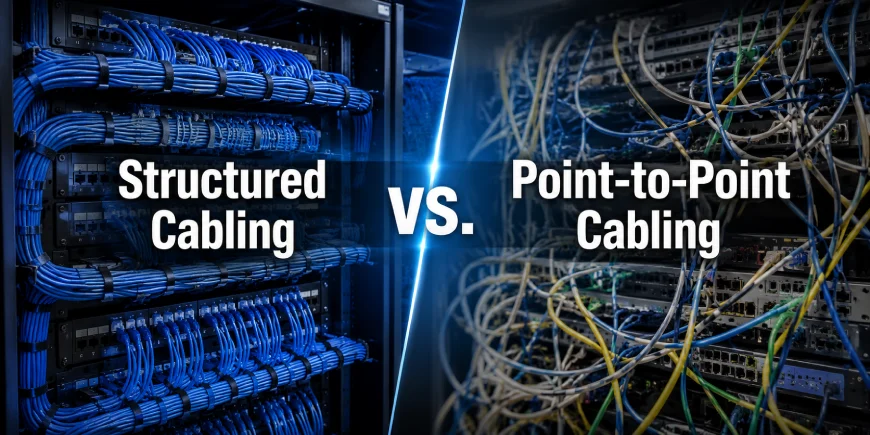
When comparing structured cabling vs. point-to-point cabling, the main difference is organization. Structured cabling uses a planned, standardized system with central distribution points. Point-to-point cabling connects devices directly, often through separate cable runs designed for individual needs.
For businesses planning network infrastructure, CCTV, access control, or communication systems, a professional Security Camera Installation Company in Canada can coordinate security technology with the building’s cabling design. This helps reduce cable congestion, simplify maintenance and support future system growth.
Both methods can work, but they are suited to different types of projects. The best option depends on building size, technology requirements, budget and expected expansion.
What Is Structured Cabling?
Structured cabling is an organized infrastructure designed to support multiple communication and technology systems through a standardized cabling layout.
Instead of installing separate, unplanned cables whenever a new device is added, structured cabling uses defined pathways, equipment rooms, patch panels, telecommunications outlets and labeled connections.
A typical structured cabling system may include:
- Entrance facilities
- Equipment rooms
- Telecommunications rooms
- Backbone cabling
- Horizontal cabling
- Work-area outlets
- Patch panels
- Cable management systems
Structured cabling can support:
- Office network cabling
- Data cabling
- Voice communication
- Wireless access points
- IP security cameras
- Access control systems
- Video intercoms
- Building automation systems
The Telecommunications Industry Association publishes standards that guide the design and installation of commercial telecommunications infrastructure. (TIA Standards)
What Is Point-to-Point Cabling?
Point-to-point cabling connects one device directly to another device or equipment location.
For example, a cable may run directly from a security camera to a recorder, or from a workstation to a network switch without using a standardized distribution system.
This approach may be used when:
- Only a few devices are required
- The installation is temporary
- The building is small
- The system has limited expansion needs
- A quick connection is required
Point-to-point cabling is not automatically poor-quality cabling. A properly installed direct connection can be reliable. The challenge often appears when many separate cables are added over time without a central plan.
Structured Cabling vs. Point-to-Point Cabling: Key Differences
| Feature | Structured Cabling | Point-to-Point Cabling |
| Design | Planned and standardized | Direct device-to-device connections |
| Organization | Centralized and labeled | Can become difficult to manage |
| Scalability | Strong | More limited |
| Maintenance | Easier to troubleshoot | Can become time-consuming |
| Flexibility | High | Lower as systems grow |
| Initial cost | Usually higher | Often lower for small projects |
| Long-term value | Strong | May increase maintenance costs |
| Best use | Commercial and expandable buildings | Small or temporary installations |
Installation Design and Organization
Structured Cabling Installation
A structured cabling installation begins with planning.
The design typically considers:
- Building layout
- Equipment locations
- Cable pathways
- Network requirements
- Current device quantities
- Future expansion
- Safety and code requirements
- Access for maintenance
Cables are routed through organized pathways and terminated at patch panels or telecommunications outlets. Each connection is labeled and documented.
This creates a clear system that technicians can understand without tracing every cable manually.
Point-to-Point Cabling Installation
Point-to-point cabling is usually designed around immediate requirements.
A cable may be installed directly from one device to another. This can be fast and cost-effective when only a few connections are needed.
However, repeated additions may create:
- Cable congestion
- Unlabeled connections
- Difficult troubleshooting
- Limited pathway space
- Increased risk of accidental disconnection
The installation method becomes more important as the number of devices increases.
Scalability and Future Expansion
Structured cabling is generally better suited to growing businesses.
When a new workstation, security camera, wireless access point, or access control device is added, the existing infrastructure may already include:
- Spare cable capacity
- Available patch panel ports
- Additional pathway space
- Central equipment locations
This can reduce disruption and simplify future changes.
Point-to-point cabling may work well initially but can become difficult to expand. Each new device may require a separate cable route, which can increase installation time and create congestion.
For new commercial construction, planning for future capacity is often more cost-effective than opening finished walls or ceilings later.
Maintenance and Troubleshooting
Organized infrastructure can reduce troubleshooting time.
Benefits of Structured Cabling
A properly documented system allows technicians to identify:
- Cable destinations
- Equipment connections
- Network ports
- Device locations
- Available capacity
When a connection fails, the cable can be tested and traced through a known pathway.
Challenges with Point-to-Point Cabling
In an unorganized system, technicians may need to trace cables physically to identify where they begin and end.
This can increase:
- Service time
- Labour costs
- Network downtime
- Risk of disconnecting the wrong device
Clear labeling and documentation can improve either system, but structured cabling is designed to make organization easier from the beginning.
Performance and Reliability
The cabling method alone does not determine network speed.
Performance depends on:
- Cable category
- Cable length
- Installation quality
- Connector quality
- Network equipment
- Testing results
Both structured cabling and point-to-point connections can provide reliable performance when correctly installed.
For example, Cat6 cabling installation can support many standard business networks, while Cat6A cabling services may be selected for higher-capacity applications or longer 10 Gigabit connections.
The main advantage of structured cabling is consistency. Standardized installation and testing help reduce unexpected performance problems.
Cost: Initial Investment vs. Long-Term Value
Point-to-point cabling often has a lower initial cost for small installations because it requires less planning and fewer centralized components.
Structured cabling may require additional investment in:
- Patch panels
- Equipment racks
- Cable trays
- Telecommunications rooms
- Cable management
- Labeling
- Testing
- Documentation
However, the long-term cost may be lower because moves, additions, changes and repairs are easier to manage.
A low initial installation price can become expensive if the system requires repeated rework as the business grows.
Structured Cabling for Commercial Security Systems
Modern commercial security systems often depend on reliable network infrastructure.
Structured cabling can support:
- IP security cameras
- Network video recorders
- Access control panels
- Video intercoms
- Security workstations
- Remote monitoring systems
For large properties, a planned cabling design can separate security, data and communications infrastructure while keeping equipment organized.
This is especially useful when security camera installation is combined with office networking and telecommunications cabling.
When Is Point-to-Point Cabling a Good Choice?
Point-to-point cabling may be suitable when:
- The property is small
- Only a few devices are connected
- The installation is temporary
- The system is unlikely to expand
- Existing infrastructure is limited
- The budget is very restricted
For a small office with only a few connections, a direct cabling approach may be practical.
The system should still use appropriate cable types, secure pathways, clear labels and proper testing.
When Is Structured Cabling the Better Choice?
Structured cabling is often the stronger option when:
- The building has many users or devices
- The business expects future growth
- Multiple technology systems share the infrastructure
- The property has several floors
- Network reliability is important
- Security systems will expand
- The project involves new construction
- Long-term maintenance is a priority
Commercial structured cabling is particularly useful for offices, schools, hospitals, hotels, warehouses, industrial facilities, financial institutions and multi-unit properties.
Can Structured Cabling and Point-to-Point Cabling Be Used Together?
Yes. Many buildings use a combination of both approaches.
A structured cabling system may provide the main network infrastructure, while direct point-to-point connections are used for specialized equipment or temporary requirements.
The goal is not to avoid every direct cable. The goal is to maintain an organized, documented and scalable infrastructure.
How to Choose the Right Cabling Method
Before selecting an approach, review:
- Number of devices
- Building size
- Current network requirements
- Expected business growth
- Security system plans
- Available cable pathways
- Equipment room capacity
- Maintenance requirements
- Budget
- Long-term technology goals
A professional assessment can identify where structured cabling provides value and where direct connections may be sufficient.
Conclusion
Structured cabling and point-to-point cabling can both support reliable network connections. The better choice depends on the size and future needs of the property.
Point-to-point cabling can be practical for small, simple, or temporary installations. Structured cabling provides stronger organization, easier maintenance, better scalability and greater long-term flexibility.
For commercial buildings with multiple systems and ongoing technology needs, structured cabling is often the more sustainable investment.
AlfaDefence.io provides commercial structured cabling, network cabling services, data cabling installation, telecommunications infrastructure and integrated security solutions across Halifax, Ottawa, Calgary and Canada.
Frequently Asked Questions
- What is the main difference between structured cabling and point-to-point cabling?
Structured cabling uses an organized and standardized infrastructure with central distribution points, patch panels and labeled connections. Point-to-point cabling connects devices directly. Structured systems are generally easier to expand and maintain, while direct connections may suit smaller or temporary installations.
- Is structured cabling better for commercial buildings?
Structured cabling is often better for commercial buildings because it supports multiple technology systems, simplifies maintenance and allows future expansion. It is useful for offices, warehouses, schools, hospitals, hotels and large facilities where network, security and telecommunications systems share infrastructure.
- Is point-to-point cabling less reliable?
Point-to-point cabling is not inherently less reliable. A properly installed direct connection can perform well. Problems may occur when many cables are added without planning, labeling, testing, or documentation. This can make troubleshooting and future expansion more difficult.
- Does structured cabling cost more to install?
Structured cabling may have a higher initial cost because it includes planning, patch panels, equipment racks, cable management, testing and documentation. However, it can reduce long-term costs by making system changes, maintenance, troubleshooting and future network expansion easier.
- Can structured cabling support security cameras?
Yes. Structured cabling can support IP security cameras, network video recorders, access control systems, video intercoms and remote monitoring equipment. A planned infrastructure can provide organized cable routes, reliable connections and capacity for additional security devices in the future.
- Which cable types are used in structured cabling?
Structured cabling may use Cat6, Cat6A and fiber optic cabling. Cat6 is common for standard business networks, while Cat6A supports higher-capacity connections. Fiber is often used for network backbones, long-distance links and connections between buildings or equipment rooms.
- Is structured cabling suitable for small offices?
Structured cabling can benefit small offices by improving organization and making future changes easier. The system can be scaled to the property’s needs. For a very small or temporary installation, simple point-to-point connections may be sufficient and more cost-effective.