
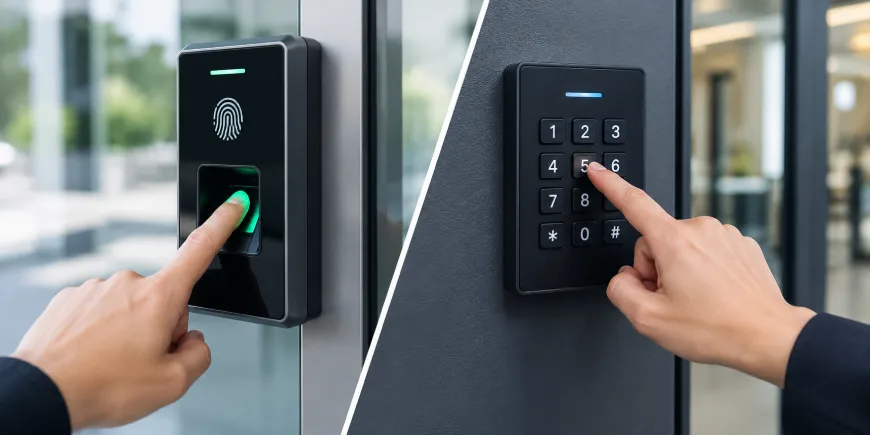
Choosing the right access control method is an important part of securing a building. Two common options are biometric access control, which identifies users through characteristics such as fingerprints or facial features and PIN-based access control, which requires users to enter a code.
For businesses planning a security camera installation company in Canada alongside access control, choosing compatible security technologies can help create a more coordinated security environment.
But which option is better? The answer depends on the type of property, number of users, security requirements, convenience, budget and how the system will be managed.
What Is Biometric Access Control?
Biometric access control verifies a person’s identity using a physical or behavioural characteristic.
Common examples include:
- Fingerprint recognition
- Facial recognition
- Iris recognition
- Palm or hand recognition
The system compares the presented biometric characteristic against information enrolled in the access control system.
The main advantage is convenience. Authorized users do not necessarily need to carry a card or remember a PIN to enter a secured area.
What Is PIN-Based Access Control?
PIN-based access control requires a user to enter a personal identification number at a keypad or access terminal.
For example, employees may receive individual PINs that allow them to enter a particular office, warehouse, equipment room, or restricted area.
PIN systems are relatively straightforward to manage and can be useful where businesses want an access method that does not require physical credentials.
However, PINs must be managed carefully. Codes that are shared, easy to guess, or not removed after an employee leaves can weaken access security.
Biometric vs. PIN-Based Access Control: Key Differences
| Factor | Biometric | PIN-Based |
| User convenience | High | Moderate |
| Physical credential required | No | No |
| Credential sharing risk | Lower | Higher |
| User enrollment | Required | Required |
| Lost credential issue | Low | None |
| Forgotten credential issue | Low | Possible |
| Installation complexity | Moderate to high | Generally lower |
| Privacy considerations | Higher | Lower |
| Best suited for | Higher-security areas | Many general commercial applications |
Neither method is automatically the right choice for every property.
Security: Which Is Safer?
Security depends on the quality of the system and how it is configured, not simply whether it uses biometrics or PINs.
A PIN can be copied, observed, or shared. A biometric system can also have risks if sensors, enrollment processes, or biometric data are poorly protected.
The National Institute of Standards and Technology (NIST) notes that biometric comparison is probabilistic and that biometric characteristics are not secrets. NIST’s current digital identity guidance therefore places specific limitations on how biometrics are used for authentication and recommends appropriate protections.
For a commercial door access system, the practical question is not just “Which technology is stronger?” It is “Which system can be securely implemented and properly managed in this building?”
Convenience and User Experience
Biometrics can make entry quick and convenient. A user simply presents an enrolled fingerprint, face, or other biometric characteristic.
PIN systems require users to remember and enter a code each time.
For locations with many employees or frequent staff changes, either system can work well, but the management process matters.
Businesses should consider:
- How many people need access
- How often users change
- Whether temporary access is required
- How quickly access must be revoked
- Whether employees need access to multiple areas
Privacy Considerations
Biometric systems require additional consideration because they process personal characteristics.
Businesses should understand:
- What biometric information is collected
- Where it is stored
- Who can access it
- How it is protected
- How users are enrolled and removed
- What happens when access is no longer required
A clear privacy and data-handling process is particularly important for organizations with many employees or sensitive facilities.
PIN-based systems generally avoid these specific biometric-data considerations, although PIN security and access records still need proper management.
Cost and Installation
PIN-based systems can be simpler and less expensive to deploy, particularly for smaller installations.
Biometric systems may require specialized readers, enrollment procedures, compatible controllers and additional configuration.
However, equipment price should not be the only consideration.
A professional access control installation company should also consider installation conditions, door hardware, wiring, network connectivity, software, user management and future expansion.
The total project cost can vary considerably depending on the number of doors and the complexity of the property.
Which Option Is Better for Different Properties?
Small Businesses
A PIN-based system may be practical for a small business with a limited number of users and straightforward access requirements.
Biometrics can make sense where the business wants stronger user identification or wants to reduce dependence on shared codes.
Warehouses and Industrial Facilities
Industrial environments may benefit from biometrics at restricted areas where identifying the individual entering the space is particularly important.
PINs can still work well for general employee access when managed properly.
Offices
Both options can work for office environments. The decision often depends on the company’s security policy, employee count, privacy requirements and desired user experience.
High-Security Areas
For highly restricted areas, businesses may combine authentication methods rather than rely on a single factor.
For example, access could require a card plus biometric verification, depending on the system and risk level.
Access Control Installation in Halifax, Ottawa and Calgary
Businesses looking for access control installation in Halifax, Ottawa, or Calgary should evaluate the entire access environment before selecting a technology.
A professional installer can review:
- Number of doors
- Door and lock types
- User volume
- Security zones
- Network requirements
- Power requirements
- Entry and exit patterns
- Existing security systems
- Future expansion
This assessment helps ensure the selected system works with the property’s physical and operational requirements.
What to Ask Before Choosing an Access Control System
Before investing in a system, ask the installer:
- How will users be enrolled and removed?
- How quickly can access be revoked?
- Can different access levels be assigned?
- Can the system generate access logs?
- What happens if the network goes offline?
- How is the system updated and maintained?
- Can it integrate with cameras or other security systems?
- Can additional doors be added later?
These questions help property owners look beyond the reader itself and understand the complete system.
Biometric or PIN: Which Should You Choose?
Choose biometric access control when:
- Individual identity is particularly important.
- You want to reduce shared credentials.
- Fast entry is a priority.
- The organization can properly manage biometric information.
- The environment justifies the additional equipment and configuration.
Consider PIN-based access control when:
- You need a straightforward access method.
- The number of users is manageable.
- Budget and simplicity are important.
- Biometric data handling is undesirable.
- The property has moderate access control requirements.
In some environments, using more than one authentication factor can provide an additional layer of protection.
Conclusion
The choice between Biometric vs. PIN-based access control should be based on the property’s actual security requirements, user population, privacy considerations, budget and management capabilities.
Biometrics can provide convenient identity-based access, while PIN systems offer a simple and flexible approach for many commercial environments. The best solution is the one that can be properly installed, securely configured, consistently managed and supported over time.
AlfaDefence.io provides professional access control and low-voltage security solutions for commercial and industrial environments, helping businesses select and implement systems based on their operational and security requirements.
FAQs
- Is biometric access control more secure than PIN-based access control?
Biometric access can reduce the risk of shared or forgotten credentials, but it is not automatically more secure. System design, enrollment, sensor quality, data protection and administration all matter. PIN systems can also provide effective security when codes are unique, properly protected, regularly managed and promptly revoked when access changes. - Which is better for commercial Access Control Installation: biometric or PIN?
Neither option is universally better. Biometrics can suit businesses that need convenient identity-based access, while PINs can work well for straightforward commercial entry. The right choice depends on user numbers, security requirements, privacy considerations, budget, door hardware and how easily administrators need to manage access. - Does biometric access control require special installation?
Biometric systems can require additional equipment and configuration compared with basic PIN systems. Installation may involve biometric readers, controllers, network connectivity, power, enrollment software and compatible door hardware. A professional installer should evaluate the site and confirm that the selected technology works properly with the building’s existing infrastructure. - Where can I get access control installation in Halifax, Ottawa, or Calgary?
Businesses can work with an experienced access control installation company serving Halifax, Ottawa, or Calgary. Before choosing a provider, ask about site assessment, door hardware, user management, access logs, system integration, testing, maintenance and future expansion so the installed solution matches your property’s requirements. - What are the privacy concerns with biometric access control?
Biometric systems process personal characteristics such as fingerprints or facial features, so organizations should understand how biometric information is collected, stored, protected, accessed and removed. Businesses should also review applicable privacy obligations and establish clear enrollment and data-handling procedures before deploying biometric access control. - Can biometric and PIN access control be used together?
Yes. Some systems support multiple authentication methods, allowing an organization to require a biometric credential, PIN, card, or combination depending on the security level. Using multiple factors can be useful for restricted areas, although the configuration should be based on the property’s risks and operational requirements. - How much does professional access control installation cost?
Costs vary based on the number of doors, reader type, controllers, door hardware, cabling, software, network requirements and installation complexity. Biometric systems may require additional equipment and configuration. A professional site assessment is the best way to determine the actual project scope and provide an accurate estimate.