
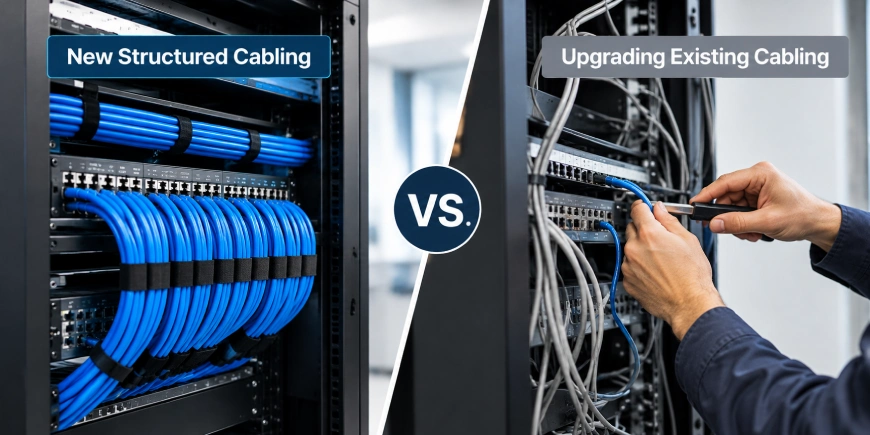
When a business network starts becoming slow, unreliable, or difficult to expand, the cabling is often one of the first things worth investigating. But should you replace the entire system or upgrade what is already there?
The answer depends on the age, condition, layout, performance and future requirements of the building. A professional security camera installation company in Canada may also assess the existing network infrastructure when security cameras, access control, Wi-Fi, or other connected systems need additional bandwidth.
This guide explains the difference between installing new structured cabling and upgrading existing cabling, including costs, performance, disruption, scalability and when each option makes sense.
What Is Structured Cabling?
Structured cabling is an organised network infrastructure designed to support data, voice, video, security systems and other connected devices.
It can include:
- Ethernet copper cabling such as Cat6 or Cat6A
- Fiber optic cabling
- Patch panels and network racks
- Telecommunications rooms
- Cable pathways and management
- Network outlets and termination points
- Testing and documentation
The Telecommunications Industry Association (TIA) develops standards covering structured cabling design, installation, testing, components, pathways and spaces. Its TIA-568 standards are widely used as a reference for commercial telecommunications cabling.
New Structured Cabling vs. Upgrading Existing Cabling: What’s the Difference?
The main difference is how much of the infrastructure needs to be replaced.
New structured cabling generally means designing and installing a new cabling infrastructure from the ground up or during a major renovation.
Upgrading existing cabling means keeping usable portions of the current system while replacing outdated, damaged, poorly installed, or underperforming components.
Neither option is automatically better. The right choice depends on the condition of the existing installation and what the network needs to support.
When New Structured Cabling Makes More Sense
A completely new installation can be the better choice when the existing infrastructure has reached the end of its useful life.
The Existing Cabling Is Outdated
Older cabling may not provide the performance required by modern networks, high-resolution security cameras, wireless access points, VoIP systems, or other connected equipment.
If the existing system has inconsistent performance or limited bandwidth, replacing it may provide a cleaner long-term solution.
The Existing Installation Is Poorly Organized
A network room filled with unidentified cables, overcrowded patch panels and poor cable management can make troubleshooting difficult.
Starting fresh allows installers to create an organized infrastructure with proper labeling, pathways, termination and documentation.
The Building Is Being Renovated
Major renovations are often an ideal opportunity to install new cabling.
Walls, ceilings and pathways may already be accessible, reducing the difficulty of routing new cables and minimizing the need to disturb finished areas later.
Future Expansion Is a Priority
A new installation can be planned around future requirements instead of simply solving today’s problems.
For example, a business may need additional network connections for:
- Security cameras
- Wi-Fi access points
- Access control
- Computers and workstations
- VoIP phones
- Building automation
- IoT devices
Planning these requirements in advance can reduce future installation work.
When Upgrading Existing Cabling Is the Better Option
Replacing everything is not always necessary. If the current infrastructure is reasonably well installed and much of it remains suitable, a targeted upgrade can be more practical.
The Existing Cabling Is in Good Condition
If cables are properly installed, labeled, tested and physically undamaged, there may be no reason to remove them simply because they are older.
A professional assessment can identify which sections can remain and which should be replaced.
Only Certain Areas Have Problems
Suppose a business has reliable cabling throughout most of its building but experiences connectivity issues in one department.
Replacing the entire infrastructure may provide little additional value. Upgrading the affected area could solve the problem while reducing installation time and disruption.
The Business Has a Limited Budget
Phased upgrades can spread infrastructure investment over time.
For example, a business could upgrade critical network areas first and address less urgent sections during future renovation or expansion projects.
Existing Pathways Can Be Reused
Good cable trays, conduits, racks and pathways may still be useful. Reusing suitable infrastructure can reduce installation complexity while allowing new cables to be introduced where necessary.
How to Decide Between Replacement and Upgrade
Before making a decision, have the existing system evaluated instead of relying only on its age.
A professional assessment should consider:
- Cable type and age – Identify the installed cable category and approximate age.
- Physical condition – Look for damaged, crushed, improperly routed, or exposed cables.
- Performance – Test connections rather than assuming the cabling works correctly.
- Termination quality – Poor terminations can cause intermittent network problems.
- Cable management – Check labeling, patch panels, racks and pathway organization.
- Capacity – Determine whether there are enough connections for current and planned devices.
- Future requirements – Consider cameras, Wi-Fi, access control, phones and network expansion.
- Building layout – Identify whether existing pathways can support new cabling.
This approach gives the property owner a clearer picture of what actually needs to change.
Cost: New Installation vs. Existing Upgrade
The cheaper option depends heavily on the building.
An upgrade may have a lower initial cost because usable cables and infrastructure can remain in place. However, selective upgrades can become complicated if technicians have difficulty identifying existing cable routes or discovering inconsistent installations.
A new installation typically requires a larger upfront investment, but it can provide:
- Consistent cable types
- Cleaner infrastructure
- Better documentation
- Easier troubleshooting
- More predictable performance
- Greater room for future expansion
The lowest initial price is not always the lowest long-term cost. A poorly documented network can increase maintenance and troubleshooting expenses over time.
Don’t Forget Testing and Documentation
Whether you install new cabling or upgrade an existing system, testing is an important part of the project.
A professional installer should verify connections and identify problems before the network is put into regular operation.
Documentation should also identify important information such as:
- Cable routes
- Patch panel ports
- Outlet locations
- Cable labels
- Network room locations
- Fiber connections
- Testing results
This information becomes valuable when equipment is replaced, new devices are added, or troubleshooting is required.
Structured Cabling for Security and Connected Systems
Modern businesses increasingly rely on one network infrastructure to support multiple systems.
Security cameras, wireless access points, access control devices, computers, phones and other equipment may all depend on reliable connectivity.
For this reason, structured cabling should not be considered only an IT requirement. It can also support the physical security and operational systems of a building.
TIA notes that its cabling standards address a range of voice, data, video and other low-voltage applications.
Structured Cabling Installation in Halifax, Ottawa and Calgary
The decision between replacement and upgrade can vary depending on the building, its age, layout and existing infrastructure.
Businesses looking for structured cabling installation in Halifax, structured cabling installation in Ottawa, or structured cabling installation in Calgary should begin with an assessment rather than automatically replacing every cable.
A qualified structured cabling installation company can inspect the current infrastructure, identify usable components, test performance and recommend whether a complete installation or phased upgrade is appropriate.
For offices, warehouses, schools, healthcare facilities, industrial sites, retail properties and other commercial environments, the goal should be reliable infrastructure that can support current operations and future technology.
New Installation or Upgrade: Which Is Right for You?
Choose new structured cabling when:
- The existing system is outdated or unreliable.
- Cable routes are poorly documented.
- The infrastructure has been modified repeatedly over the years.
- The building is undergoing major renovation.
- Future network demand will increase significantly.
- Existing cabling cannot support planned systems.
Consider upgrading existing cabling when:
- Most cables are still in good condition.
- Problems are limited to specific areas.
- Existing pathways and racks can be reused.
- Current infrastructure passes appropriate testing.
- The business wants to upgrade in phases.
- A full replacement would create unnecessary disruption.
In some cases, the best solution is a hybrid approach: retain suitable infrastructure while replacing sections that are outdated or unsuitable.
Conclusion
The decision between new structured cabling vs. upgrading existing cabling should be based on infrastructure condition, current performance, business requirements, budget and future expansion—not simply on the age of the cables.
A proper assessment can reveal whether selective upgrades are enough or whether starting with a new structured cabling system will provide better long-term value.
For businesses planning network, surveillance, access control and other low-voltage improvements, AlfaDefence.io can help evaluate infrastructure requirements and plan reliable cabling solutions for commercial and industrial environments.
FAQs
- Should I install new structured cabling or upgrade existing cabling?
It depends on the condition and performance of your current infrastructure. If cables are damaged, outdated, poorly documented, or unable to support future requirements, new installation may be better. If most cabling remains reliable and test results are good, a targeted upgrade can be more practical and cost-effective. - How do I know if my existing structured cabling needs replacement?
Look for frequent connectivity problems, damaged cables, poor terminations, missing labels, outdated cable categories, insufficient network connections and difficult troubleshooting. Professional testing can provide a clearer answer than visual inspection alone and can identify which cables should remain and which require replacement. - Is structured cabling installation expensive for a commercial building?
The cost varies based on building size, cable type, number of outlets, pathways, labor, testing and whether existing infrastructure can be reused. A professional assessment can help determine the actual scope before installation begins, making it easier to compare a complete replacement with a phased upgrade. - Can existing cabling be reused during a structured cabling upgrade?
Yes, provided the existing cables are suitable, properly installed, physically sound and capable of meeting the required performance. Testing should be completed before reuse. Suitable racks, pathways, patch panels and other infrastructure may also be retained when they meet project requirements. - Where can I get structured cabling installation in Halifax, Ottawa, or Calgary?
Businesses can work with a professional structured cabling installation company that serves their location. A qualified installer should assess existing infrastructure, understand current and future network requirements, recommend appropriate cabling, complete installation, test connections and provide useful documentation. - Should new structured cabling be installed during a building renovation?
Yes. Renovations can provide an excellent opportunity to install new cabling because walls, ceilings, pathways and other areas may already be accessible. Planning cabling during renovation can reduce future disruption and make it easier to support security cameras, Wi-Fi, access control, networking and other connected systems. - Why is professional structured cabling installation important?
Professional installation helps ensure that cables are routed, terminated, labeled, tested and documented correctly. Proper installation also makes future maintenance easier and can reduce troubleshooting problems. For commercial environments, a well-organised infrastructure provides a stronger foundation for network and security systems.