
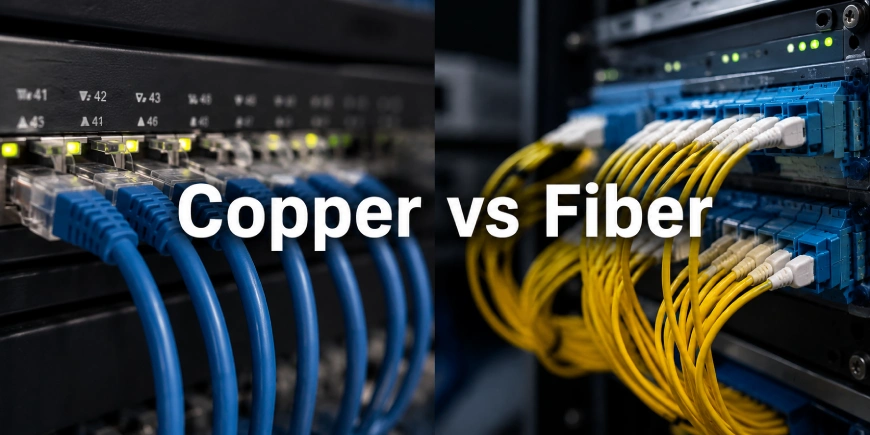
Commercial buildings depend on reliable network infrastructure to support business operations, security systems, communication platforms, cloud applications and connected devices. Choosing between copper and fiber cabling can affect network performance, installation costs, future expansion and long-term maintenance.
The right infrastructure is not always the fastest or most expensive option. It should match the building’s size, device requirements, cable distances and future technology plans. A professional Security Camera Installation Company in Canada can assess network requirements alongside CCTV, access control and other low voltage systems to create a coordinated infrastructure plan.
In many commercial projects, copper and fiber are used together. Fiber provides high-capacity connections between network rooms or buildings, while copper cabling connects individual devices such as computers, IP cameras, wireless access points and access control equipment.
What Is Copper Network Infrastructure?
Copper infrastructure uses electrical signals to transmit data through metal conductors. Common copper network cables include:
- Cat5e
- Cat6
- Cat6a
- Shielded twisted-pair cables
Copper cabling is widely used inside commercial buildings because it is practical, cost-effective and compatible with many network devices.
A typical copper network may connect:
- Desktop computers
- IP security cameras
- Wireless access points
- IP phones
- Access control panels
- Video intercom systems
- Building automation devices
Copper Ethernet cabling can also support Power over Ethernet, or PoE. This allows compatible devices to receive power and data through one cable.
What Is Fiber Optic Infrastructure?
Fiber optic cabling transmits data using pulses of light through thin strands of glass or plastic.
Fiber is commonly used for:
- Network backbones
- Building-to-building connections
- Long cable runs
- Data centres
- High-capacity commercial networks
- Large campuses
- Industrial facilities
Fiber can transmit large amounts of data over much longer distances than standard copper Ethernet cables. It is also resistant to electromagnetic interference.
Common types include:
- Single-mode fiber
- Multimode fiber
Single-mode fiber is generally used for longer distances, while multimode fiber is often used for shorter high-speed connections within buildings or campuses.
Copper vs Fiber Infrastructure: Key Differences
| Feature | Copper Infrastructure | Fiber Infrastructure |
| Data transmission | Electrical signals | Light signals |
| Typical horizontal distance | Up to 100 metres | Hundreds of metres to many kilometres |
| Network capacity | High, depending on cable category | Very high |
| Power delivery | Supports PoE | Does not normally provide device power |
| Electromagnetic interference | Can be affected | Highly resistant |
| Installation | Familiar and generally straightforward | Requires specialized tools and skills |
| Initial cost | Often lower | Often higher |
| Device connections | Excellent for end devices | Commonly used for backbone connections |
| Future scalability | Good | Excellent |
Speed and Network Capacity
Fiber generally provides greater bandwidth and supports higher network speeds over longer distances.
This makes it useful for commercial buildings with:
- Large data transfers
- Multiple network closets
- High-density wireless networks
- Large video surveillance systems
- Data-intensive applications
- Multiple connected facilities
Copper remains capable of supporting high-performance networks. Cat6a, for example, can support 10 Gigabit Ethernet over standard commercial channel distances when properly installed.
The Institute of Electrical and Electronics Engineers develops networking standards used across Ethernet technologies, including standards for high-speed wired communication. (IEEE Standards Association)
The correct choice depends on the required performance at each part of the network.
Distance Limitations
Distance is one of the most important factors in the copper vs fiber infrastructure comparison.
Copper Cable Distance
Standard Ethernet copper channels are commonly designed for distances up to 100 metres, including permanent cabling and patch cords.
This is suitable for many office floors and commercial spaces. However, longer distances may require additional network equipment or another cabling method.
Fiber Cable Distance
Fiber can carry data over much longer distances without the same limitations.
Fiber may be suitable for:
- Connecting separate buildings
- Linking network rooms on large campuses
- Supporting long industrial facilities
- Extending networks across warehouses
- Connecting remote equipment areas
For long-distance commercial network connections, fiber often provides a more practical and reliable solution.
Power over Ethernet and Device Connectivity
Copper has an important advantage: it can deliver both data and electrical power through one Ethernet cable.
PoE is commonly used for:
- IP security cameras
- Wireless access points
- Access control devices
- Video intercoms
- IP phones
- Smart building sensors
This can reduce the need for separate electrical outlets near each device.
Fiber does not normally deliver PoE directly. A fiber-connected location may require a local power source, network switch, or media conversion equipment.
For this reason, many commercial networks use fiber for backbone connections and copper for the final connection to devices.
Reliability and Interference
Fiber is highly resistant to electromagnetic interference because it transmits light rather than electrical signals.
This can be useful in:
- Industrial facilities
- Manufacturing environments
- Electrical rooms
- Areas with large motors
- Locations with heavy electrical equipment
Copper cabling can also perform reliably when correctly installed. Proper cable separation, grounding, shielding and pathway design can help reduce interference.
Installation quality is important. Poor cable routing, excessive bending, damaged insulation, or incorrect termination can affect performance regardless of the cable type.
Installation and Maintenance
Copper Installation
Copper cabling is widely understood by commercial low voltage contractors. Installation usually includes:
- Cable routing
- Patch panel termination
- Data outlet installation
- Cable labeling
- Performance testing
- Documentation
Copper is generally flexible and easier to terminate in the field.
Fiber Installation
Fiber installation requires specialized equipment and trained technicians. Depending on the project, work may include:
- Fiber pulling
- Fusion splicing
- Connector installation
- Optical testing
- Loss measurement
- Cable protection
- Documentation
Fiber cables can be physically delicate and require careful handling. However, properly installed fiber infrastructure can provide reliable performance for many years.
Cost Comparison
Copper usually has a lower initial cost for standard device connections.
Fiber may involve higher costs for:
- Cable materials
- Optical transceivers
- Specialized installation
- Splicing
- Testing equipment
- Network hardware
However, the lowest installation cost is not always the best long-term value.
Fiber may reduce future upgrade costs in large facilities because it provides significant capacity for growth. Installing fiber during new construction may also be more economical than adding it after walls and ceilings are complete.
A complete cost review should include:
- Installation labour
- Network equipment
- Cable pathways
- Testing
- Maintenance
- Future expansion
- Downtime risks
Copper vs Fiber for Security Systems
Commercial security systems often use both cable types.
Copper for Security Devices
Copper network cabling is commonly used to connect:
- IP security cameras
- Access control panels
- Intercom systems
- Security workstations
PoE can power many of these devices without separate electrical wiring.
Fiber for Security Network Backbones
Fiber may connect:
- Security control rooms
- Remote buildings
- Network equipment rooms
- Large parking facilities
- Warehouse sections
- Campus security systems
For example, a large industrial property may use fiber between buildings and Cat6 or Cat6a cabling from local network switches to individual cameras.
This hybrid approach can provide both long-distance capacity and practical device connectivity.
Scalability and Future Growth
Fiber generally offers greater long-term scalability because it supports high-capacity communication and can accommodate future network upgrades without replacing the physical cable.
Copper also provides strong performance for many commercial applications. However, future speed requirements may eventually require upgrades to higher cable categories.
When planning low voltage infrastructure, consider:
- Expected business growth
- Additional building space
- New security cameras
- Increased wireless coverage
- Building automation systems
- Cloud applications
- Future network speeds
A well-planned low voltage design should allow for expansion without major disruption.
When Should Commercial Buildings Choose Copper?
Copper may be the right choice when:
- Cable runs are within standard Ethernet distances
- Devices require PoE
- The project involves office workstations
- IP cameras are installed throughout the building
- Installation budgets are limited
- Existing copper infrastructure is usable
Copper is often the practical choice for horizontal network cabling and individual device connections.
When Should Commercial Buildings Choose Fiber?
Fiber may be the better choice when:
- Long cable distances are required
- Multiple buildings must be connected
- High network capacity is needed
- The environment has significant electrical interference
- The network is expected to grow substantially
- The project includes a large commercial campus
- High-capacity backbone connections are required
Fiber is especially valuable for backbone infrastructure where performance, distance and future capacity are priorities.
Why Many Commercial Buildings Use Both
The choice is often not copper or fiber. It is copper and fiber.
A common commercial design includes:
- Fiber optic cabling between network rooms or buildings
- Network switches at each local equipment room
- Cat6 or Cat6a cabling from switches to devices
- PoE connections for cameras, access control and wireless equipment
This design combines the strengths of both technologies and can support integrated low voltage solutions across the property.
How to Choose the Right Infrastructure
Before selecting a cable type, review:
- Building size
- Maximum cable distances
- Number of connected devices
- Required network speeds
- PoE requirements
- Existing infrastructure
- Security system requirements
- Future expansion
- Installation environment
- Long-term maintenance
A commercial low voltage contractor should evaluate the entire system rather than selecting cable based only on initial material cost.
Conclusion
Copper and fiber infrastructure both play important roles in commercial buildings.
Copper is cost-effective, supports PoE and works well for connecting individual devices. Fiber provides high capacity, long-distance performance, resistance to electrical interference and strong future scalability.
For many businesses, a hybrid design provides the best balance. Fiber supports the network backbone, while copper connects cameras, access control systems, wireless equipment and other devices.
AlfaDefence.io provides low voltage design and installation, commercial network cabling, integrated security infrastructure and scalable technology solutions for businesses across Halifax, Ottawa, Calgary and Canada.
Frequently Asked Questions
Is fiber better than copper for commercial buildings?
Fiber provides higher capacity, longer transmission distances and strong resistance to electromagnetic interference. Copper is more practical for connecting individual devices and supporting PoE. Many commercial buildings use both technologies because each serves a different part of the network infrastructure.
- When should a commercial building use fiber optic cabling?
Fiber optic cabling is useful for long-distance network connections, building-to-building links, large campuses, high-capacity backbones and environments with electrical interference. It is often installed between network rooms, while copper cabling connects individual devices throughout each building area.
- Can fiber optic cabling power security cameras?
Standard fiber optic cabling does not provide Power over Ethernet. IP security cameras connected through fiber usually require local power or a nearby network switch with PoE capability. Fiber can carry network data to the area, while copper provides the final powered connection.
- Is copper cabling enough for commercial security systems?
Copper cabling is suitable for many commercial security systems, including IP cameras, access control devices, intercoms and wireless access points. Cat6 or Cat6a can support data and PoE. Large properties may use fiber for backbone connections and copper for devices.
- Is fiber more expensive than copper infrastructure?
Fiber installation may have higher initial costs because it requires specialized equipment, optical components, splicing and testing. However, fiber can provide long-term value through high capacity, long-distance performance and reduced infrastructure upgrades as commercial network requirements grow.
- How long can copper and fiber network cables run?
Standard copper Ethernet channels are commonly designed for distances up to 100 metres. Fiber can support much longer distances, ranging from hundreds of metres to many kilometres depending on fiber type, network equipment and required data speed.
- Should new commercial buildings install both copper and fiber?
Many new commercial buildings benefit from installing both. Fiber can support high-capacity backbone connections between network rooms or buildings, while copper provides practical connections and PoE for devices. This approach supports current operations and allows future expansion.