
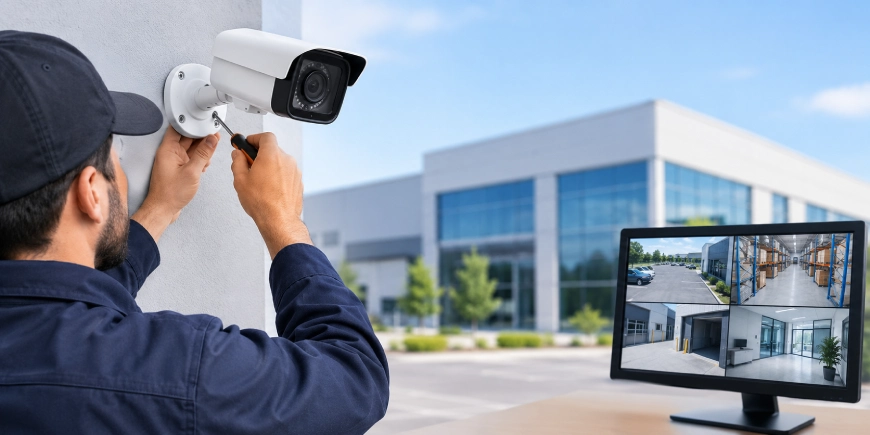
A security camera system is only useful when it provides clear coverage, reliable recording and easy access to the footage when it matters. Buying good cameras is important, but the installation itself can have just as much impact on system performance.
Working with a professional security camera installation company in Canada can help businesses and property owners choose suitable equipment, position cameras correctly, configure recording and test the complete system before it goes into daily use.
From small businesses and homes to warehouses, schools, healthcare facilities and industrial properties, professional installation can reduce common problems and provide a more dependable surveillance system.
What Does Professional Security Camera Installation Include?
Professional installation involves more than mounting cameras on walls or ceilings.
Depending on the property, the process may include:
- Assessing security risks and important areas
- Selecting suitable camera types
- Planning camera locations
- Installing cameras and mounting hardware
- Running network or coaxial cabling
- Configuring NVRs or other recording equipment
- Setting up PoE switches where required
- Configuring user access and remote viewing
- Testing video quality and coverage
- Providing basic system documentation
The exact process depends on the size and design of the property, but proper planning should come before installation.
1. Better Camera Placement and Coverage
One of the biggest benefits of professional installation is proper camera positioning.
A camera can be high quality but still provide poor evidence if it is pointed at the wrong angle or installed where lighting creates glare.
An experienced installer considers:
- Building entrances and exits
- Parking areas
- Loading zones
- Cash registers or transaction areas
- Hallways and restricted areas
- Storage rooms
- Perimeter zones
- Blind spots
- Lighting conditions
The goal is not simply to install as many cameras as possible. It is to achieve useful coverage with appropriate viewing angles.
2. Fewer Blind Spots
Blind spots are one of the most common weaknesses in poorly planned surveillance systems.
A professional installer can review the property from different angles and identify areas that may not be visible from the initial camera positions.
For larger properties, the assessment may also consider how people and vehicles move through the site.
This is particularly useful for warehouses, parking facilities, commercial buildings, industrial sites and properties with multiple entrances.
3. Reliable Cabling and Power
Security cameras depend on more than the camera itself. Network connections, power delivery, switches, recording equipment and other infrastructure must work together.
For IP cameras, proper Ethernet cabling and Power over Ethernet (PoE) planning can simplify installation while providing both connectivity and power through suitable network infrastructure.
Professional security camera system installation services can include cable routing, termination, labeling, testing and network configuration.
This helps reduce issues caused by loose connections, poor cable routes, damaged cables, or inadequate power.
4. Proper Recording Configuration
A surveillance system is not very useful if it records incorrectly.
Professional installation includes configuring the recording system according to the property’s needs.
This may involve:
- Recording schedules
- Continuous recording
- Motion-based recording
- Storage capacity
- Camera resolution
- Retention requirements
- Date and time settings
- User permissions
- Playback configuration
The installer can also verify that cameras are actually recording and that recorded footage can be retrieved.
5. Better Video Quality
Professional installation can help a camera perform closer to its intended capabilities.
Installers consider factors such as camera height, viewing angle, distance from the target, lighting, reflections and nighttime conditions.
For example, a camera installed directly facing a bright entrance may produce an image with excessive contrast. Changing the angle or selecting a more appropriate camera can improve the usable footage.
Small installation decisions can make a noticeable difference in real-world surveillance.
6. More Secure System Configuration
Modern security cameras are connected devices, so cybersecurity should also be considered during installation.
Professional configuration should include changing default credentials, limiting unnecessary access and keeping the system appropriately protected.
CISA recommends changing default manufacturer passwords before hardware, software and firmware are connected to a network. It also recommends appropriate controls for remotely accessible systems.
This is particularly important when remote viewing is enabled.
7. Easier Remote Monitoring
Many modern systems allow authorised users to view cameras from computers, tablets, or smartphones.
A professional setup can help ensure remote access works correctly without unnecessarily exposing the system.
Depending on the equipment, installers may configure:
- Mobile applications
- User accounts
- Remote viewing
- Notifications
- Multi-user permissions
- Secure network access
The objective is convenient access without treating remote connectivity as an afterthought.
8. Professional Testing Before Handover
A reliable installation should be tested before the project is considered complete.
Testing can include checking:
- Daytime video
- Nighttime visibility
- Camera angles
- Recording
- Playback
- Motion detection
- Remote access
- Network connectivity
- PoE power
- Storage
- Date and time accuracy
Testing gives property owners confidence that the system works as expected rather than discovering problems after an incident.
9. Lower Long-Term Maintenance Problems
Poor installation can create recurring problems.
A cable may be difficult to trace, a camera may lose connection, a recorder may fill up unexpectedly, or an incorrectly positioned camera may need to be moved later.
Professional installation focuses on organization and documentation from the beginning.
Clear labeling and a documented system layout can make future troubleshooting, maintenance and expansion much easier.
10. A System Designed Around the Property
Every building has different security requirements.
A small retail store may need strong coverage around entrances and checkout areas, while a warehouse may require cameras covering loading docks, aisles, exterior areas and vehicle movement.
Professional security camera system installation services should therefore begin with the property rather than simply using the same camera layout everywhere.
This approach can help avoid unnecessary equipment while ensuring important areas receive adequate coverage.
Security Camera System Installation in Halifax, Ottawa and Calgary
Businesses looking for security camera system installation in Halifax, security camera system installation in Ottawa, or security camera system installation in Calgary should consider more than camera specifications when choosing an installer.
Look for an installation provider that can explain:
- Why specific camera locations were selected
- What recording solution is being used
- How footage will be stored
- How remote access will be secured
- What testing is included
- What documentation will be provided
- How future expansion can be handled
A transparent installation process makes it easier for property owners to understand what they are paying for.
Who Can Benefit From Professional Installation?
Professional surveillance installation can be useful for:
- Homeowners
- Small businesses
- Commercial buildings
- Warehouses
- Industrial facilities
- Schools
- Hospitals and clinics
- Hotels
- Apartment properties
- Banks
- Government facilities
- Parking facilities
- Construction sites
- Event venues
The system can then be designed around the property’s specific risks, layout, operating hours and monitoring requirements.
Choosing a Security Camera Installation Company
Before hiring a security camera system installation company, ask about the complete installation process rather than focusing only on equipment prices.
A reliable provider should be able to explain the proposed camera locations, cabling requirements, recording solution, system configuration, testing process and ongoing support.
Experience with both security equipment and low-voltage infrastructure is also valuable because the camera system depends heavily on the underlying network and cabling.
Conclusion
The Benefits of Professional Security Camera system installation goes beyond simply having cameras mounted around a property. Proper planning, camera placement, cabling, recording configuration, cybersecurity, testing and documentation all contribute to a more dependable surveillance system.
For businesses and property owners, the goal should be a system that provides useful coverage today while remaining practical to maintain and expand in the future.
AlfaDefence.io provides professional security and low-voltage infrastructure solutions designed to support commercial and industrial security requirements across Canada.
FAQs
- Why is professional security camera system installation better than DIY installation?
Professional installation considers camera placement, blind spots, cabling, power, recording, network configuration and system security. A DIY setup may work for basic needs, but professional installation can provide more consistent coverage, cleaner infrastructure, proper testing and easier troubleshooting when the system is used for serious security requirements. - What is included in professional security camera system installation?
Professional installation can include site assessment, camera selection, placement planning, mounting, cabling, PoE configuration, NVR setup, recording configuration, remote access, user permissions, testing and documentation. The exact scope depends on the property, number of cameras, network infrastructure, storage requirements and desired monitoring features. - How does professional camera installation reduce blind spots?
An experienced installer reviews entrances, exits, corridors, parking areas, perimeter zones and other important locations before mounting cameras. Camera height, viewing angle, lighting and surrounding structures are considered. This planning helps reduce areas that may remain hidden from the surveillance system. - How much does Security Camera System Installation cost?
Installation costs vary according to the number and type of cameras, cabling distance, building layout, recording equipment, storage requirements, network infrastructure and installation complexity. A professional site assessment provides a more accurate estimate because the actual installation conditions can significantly affect project requirements. - Where can I get Security Camera System Installation in Halifax, Ottawa, or Calgary?
Businesses can work with a qualified Security Camera System Installation Company serving their area. Before hiring a provider, ask about camera placement, cabling, recording, remote access, testing, documentation, warranty and ongoing support to make sure the installation meets the property’s security requirements. - Is professional installation important for commercial security cameras?
Yes. Commercial systems often cover larger areas and may support multiple cameras, recording devices, network equipment, access control and remote monitoring. Professional installation helps coordinate these components, reduce blind spots, organize infrastructure and ensure the system is properly configured and tested before use. - Can a professionally installed security camera system be expanded later?
Yes, if expansion is considered during the original design. Installers can account for available network ports, PoE capacity, cable pathways, recording storage and future camera locations. Planning for growth can make it easier to add cameras or other connected security devices without redesigning the entire system.