
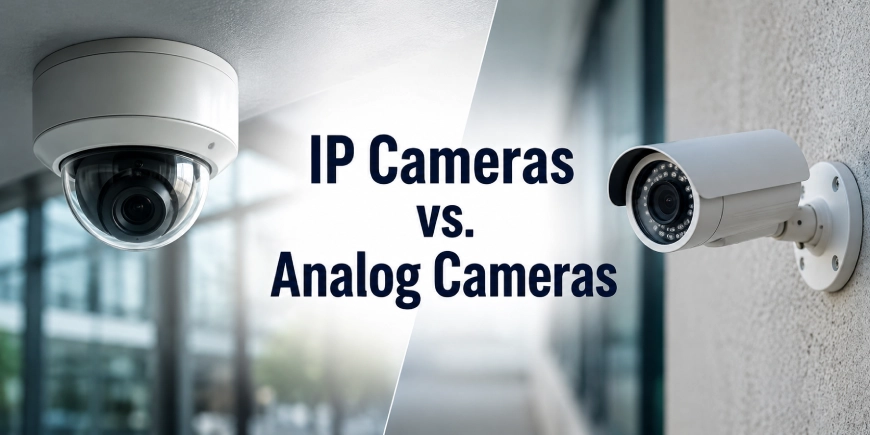
Choosing between IP cameras and analog cameras is an important decision when planning a new security system. Both technologies can provide dependable video surveillance, but they differ in image quality, installation methods, storage, remote access, scalability and long-term capabilities.
Whether you are protecting a home, office, warehouse, school, healthcare facility, retail store, or industrial property, the right option depends on your security goals and existing infrastructure. Working with an experienced security camera installation company in Canada can help you evaluate camera placement, network capacity, recording requirements and future expansion before investing in equipment.
In many modern projects, IP security cameras offer greater flexibility and advanced features. However, analog CCTV cameras can still be a practical choice for smaller installations or properties with existing coaxial cabling.
What Is an IP Camera?
An IP camera, or Internet Protocol camera, captures video digitally and sends it through a local network. The footage may be recorded on a Network Video Recorder (NVR), stored on a server, or supported through secure cloud video storage.
IP cameras commonly use Ethernet cables and can receive power through the same cable using Power over Ethernet (PoE). This can reduce the number of separate cables required at each camera location.
Modern IP systems may include:
- High-definition or 4K video
- Remote monitoring through computers or mobile devices
- Motion detection alerts
- Night vision cameras
- Two-way audio
- AI video analytics
- Smart event notifications
- Access control integration
Because IP cameras operate on a network, proper system design is important. Network bandwidth, switch capacity, cybersecurity, storage requirements and structured cabling should be reviewed before installation.
What Is an Analog Camera?
Analog cameras transmit video signals through coaxial cables to a Digital Video Recorder (DVR). The DVR processes and stores the footage.
Traditional analog systems were known for lower video resolution, but newer HD-over-coax technologies can provide much clearer images than older analog equipment. This makes analog systems a reasonable option when existing coaxial cabling is in good condition.
An analog CCTV system may be suitable when:
- The property already has usable coaxial cables
- The installation is relatively small
- The budget is limited
- Advanced analytics are not required
- The owner prefers a straightforward recording system
Analog technology remains useful, particularly when upgrading an older system without replacing all existing cabling.
IP Cameras vs. Analog Cameras: Key Differences
| Feature | IP Cameras | Analog Cameras |
| Video quality | HD, 4K and higher-resolution options | Standard, HD and HD-over-coax options |
| Video transmission | Ethernet network | Coaxial cable |
| Recording system | Network Video Recorder (NVR) | Digital Video Recorder (DVR) |
| Remote monitoring | Usually flexible and feature-rich | Available on many modern systems |
| Smart analytics | Common on advanced models | More limited, depending on the system |
| Scalability | Easy to expand with proper network planning | May require additional DVR channels and cabling |
| Installation | Requires network planning | Often simpler when coaxial wiring already exists |
| Initial cost | Usually higher | Often lower |
| Long-term flexibility | Strong | More limited |
Image Quality and Video Detail
Image quality is one of the biggest differences in the IP cameras vs. analog cameras comparison.
IP cameras are available in a wide range of resolutions, including 1080p, 4K and higher. Greater resolution can provide more detail when reviewing faces, vehicles, entrances, loading areas, or large outdoor spaces.
Higher resolution does not automatically mean better security. A poorly positioned 4K camera may provide less useful evidence than a correctly positioned lower-resolution camera. Camera height, viewing angle, lighting, lens selection and scene coverage all affect the final result.
Modern video surveillance systems have developed from traditional analog recording toward network-based systems that support higher-resolution video, remote access and integration with other technologies.
Installation and Cabling Requirements
IP Camera Installation
IP cameras usually connect through Ethernet cabling. PoE cameras can receive data and electrical power through one network cable, which can simplify installation.
A professional installation should assess:
- Network switch capacity
- Available bandwidth
- Cable distances
- Equipment room layout
- Backup power requirements
- Network security
- Future camera expansion
For larger commercial properties, structured cabling can create a cleaner and more organized infrastructure. Proper low voltage wiring also helps reduce troubleshooting issues and supports long-term maintenance.
Analog Camera Installation
Analog cameras typically use coaxial cables for video transmission. They may also require separate power wiring, depending on the system design.
If a building already has functional coaxial cabling, upgrading to HD-over-coax cameras may reduce installation costs. In some cases, existing cabling can also support a gradual move toward network video using compatible conversion equipment.
Remote Monitoring and Mobile Access
Remote monitoring allows users to view live or recorded footage from a smartphone, tablet, or computer.
Both IP and modern analog systems can support mobile monitoring. However, IP-based systems often provide more flexible remote access, advanced notifications and easier integration with other connected security technologies.
For example, a commercial property manager may receive a motion alert after business hours, open the mobile application, review the live camera feed and determine whether further action is necessary.
Remote access should be configured securely. Strong passwords, updated firmware, controlled user permissions and protected network access are important for reducing cybersecurity risks. CISA recommends limiting unnecessary network exposure and using secure network protections for connected systems.
Smart Features and AI Video Analytics
This is an area where IP security cameras often have a clear advantage.
Advanced IP systems may support:
- Person detection
- Vehicle detection
- Line-crossing alerts
- Restricted-area monitoring
- Object detection
- People counting
- License plate recognition
- Unusual activity alerts
These tools can reduce unnecessary notifications by identifying relevant events instead of treating every movement as a security concern.
AI video analytics should support security personnel, not replace proper monitoring procedures. The accuracy of analytics can be affected by lighting, weather, camera position, scene complexity and system configuration.
Storage: NVR vs. DVR
IP cameras generally record through an NVR, while analog cameras typically use a DVR.
Storage requirements depend on several factors:
- Number of cameras
- Camera resolution
- Recording hours
- Frame rate
- Video compression
- Motion-based or continuous recording
- Required retention period
A 4K security camera can provide more detail, but it may also require more storage and network bandwidth. Before selecting equipment, calculate how long footage must be retained and how much storage the system will need.
Cloud video storage may provide additional flexibility, but recurring costs, internet reliability, privacy requirements and upload bandwidth should be considered.
Cost: Which System Is More Affordable?
Analog systems often have a lower initial equipment cost, especially for small properties. Existing coaxial cabling may further reduce installation expenses.
IP systems may cost more upfront because they can require network switches, PoE equipment, structured cabling and additional configuration. However, they may offer better scalability, higher image quality, advanced analytics and easier integration.
The lowest purchase price is not always the lowest long-term cost.
When comparing quotes, consider:
- Equipment quality
- Installation labour
- Cabling requirements
- Storage capacity
- Software licensing
- Maintenance
- Future expansion
- Cybersecurity management
Which Camera System Is Best for Your Property?
Choose IP Cameras If You Need:
- High-resolution video
- 4K security cameras
- Advanced AI video analytics
- Flexible remote monitoring
- Smart surveillance features
- Easy system expansion
- Integration with access control
- Centralized management across multiple locations
IP systems are often well suited to commercial properties, industrial facilities, schools, hospitals, warehouses, hotels, government buildings and large residential developments.
Choose Analog Cameras If You Need:
- A lower initial investment
- A straightforward CCTV system
- Compatibility with existing coaxial wiring
- A smaller number of cameras
- Basic monitoring and recording
Analog systems may be suitable for homes, small offices, small retail locations and properties where advanced analytics are unnecessary.
A Hybrid Upgrade May Be the Best Option
You do not always have to replace an entire analog system at once.
Some properties use a phased approach by keeping existing analog cameras while adding IP cameras in high-priority areas. Video encoders and compatible equipment may allow older infrastructure to connect with newer network-based technology.
A hybrid strategy can help spread costs while improving coverage over time.
How to Choose the Right System
Before purchasing cameras, answer these questions:
- What areas require monitoring?
- Do you need facial or vehicle detail?
- How many cameras are required now?
- Will the system expand later?
- Is existing coaxial or network cabling available?
- Do users need remote or mobile access?
- Are AI analytics useful for the property?
- How long must recordings be retained?
- Does the system need access control integration?
- What level of cybersecurity is required?
A site assessment is valuable because every property has different lighting conditions, cable routes, network limitations and security risks.
Conclusion
The choice between IP cameras and analog cameras depends on your property, budget, infrastructure and long-term security goals.
IP cameras generally provide stronger image quality, smart analytics, remote access, scalability and integration options. Analog cameras can remain a cost-effective solution for smaller systems or properties with usable coaxial infrastructure.
The best system is not simply the newest technology. It is the system that provides useful coverage, reliable recording, secure access and room for future growth.
AlfaDefence.io helps businesses and property owners evaluate security requirements and plan dependable camera infrastructure for projects in Halifax, Ottawa, Calgary and other locations across Canada.
Frequently Asked Questions
- Are IP cameras better than analog cameras?
IP cameras generally offer higher resolution, advanced analytics, flexible remote monitoring and easier expansion. However, analog cameras may be more affordable for smaller properties or locations with existing coaxial cabling. The best option depends on security requirements, available infrastructure and long-term plans.
- Do IP security cameras require internet access?
IP security cameras do not always require internet access for local recording. A camera can operate on a private network and record to an NVR. Internet access is mainly needed for remote monitoring, mobile viewing, cloud video storage, software updates and off-site access.
- Is an NVR better than a DVR?
An NVR is designed for network-based IP cameras, while a DVR is commonly used with analog CCTV cameras. NVR systems often support higher-resolution video, flexible camera placement and advanced features. The better option depends on the camera technology and system requirements.
- Can I replace analog cameras with IP cameras?
Yes. Some properties can upgrade gradually by reusing parts of their existing infrastructure or using compatible video conversion equipment. A site assessment should confirm cable condition, network capacity, power requirements and equipment compatibility before planning the transition.
- Are 4K security cameras worth the cost?
4K security cameras can be valuable when detailed identification is required across large areas. They may need more storage and network bandwidth than lower-resolution models. Proper camera placement is essential because higher resolution alone does not guarantee better surveillance results.
- Can IP cameras work with access control systems?
Many IP camera systems can integrate with access control platforms. This can connect video events with door activity, credential use, or entry alarms. Integration may help security teams review incidents more efficiently and improve visibility around restricted entrances and sensitive areas.
- Which camera system is best for businesses in Halifax, Ottawa, or Calgary?
The right system depends on building size, lighting, network infrastructure, security risks and expansion plans. IP cameras are often preferred for scalable commercial projects, while analog systems may suit smaller installations. A professional site assessment helps determine the appropriate solution.